How to Buy Property in Miami as a Foreigner (No Visa or Residency Required): 2026 Guide for Latin American Investors
Can you buy property in Miami as a foreigner with no U.S. visa and no residency? Yes. U.S. law does not require citizenship, a green card, or an investor visa to purchase real estate. What a Latin American buyer does need is legal clarity, a strong professional team, and a realistic tax plan.
This pillar guide —written for investors and families across Latin America— covers the full 2026 process, verified South Florida market data, a seven-step roadmap, tax considerations (including FIRPTA on sale), and links to Lata Miami resources. Buying real estate does not grant a green card or immigration status.
Legal and tax disclaimer: This content is informational and educational only. It is not legal, tax, immigration, or investment advice. Federal, state, and local rules can change. Always consult a Florida-licensed real estate attorney and a qualified CPA or tax advisor before making decisions.
Can a foreigner buy in Miami without a visa or residency?
Yes. In Florida, a non-resident alien can purchase a home, condominium, townhouse, or investment property in their own name or through an entity (for example, an LLC), without living in the United States or holding a current visa at closing.
What is typically required in practice:
- Valid identification (passport) and, in many cases, an ITIN (Individual Taxpayer Identification Number) for tax reporting or certain banking steps.
- Ability to document source of funds (KYC / anti-money-laundering) for title, the bank, or escrow.
- Compliance with condo/HOA rules, Florida purchase-contract practice, and title insurance requirements.
- Professional guidance: a realtor experienced with internationals, a Florida real estate attorney, and a CPA familiar with foreign buyers.
If your goal mixes housing and immigration, that is a separate path. Lata Miami covers both topics on distinct pages: visa services and tax advisory. Buying ≠ permanent residency.
To explore inventory and purchase support, see also Buy in Miami.
Why Miami attracts Latin American buyers in 2025–2026
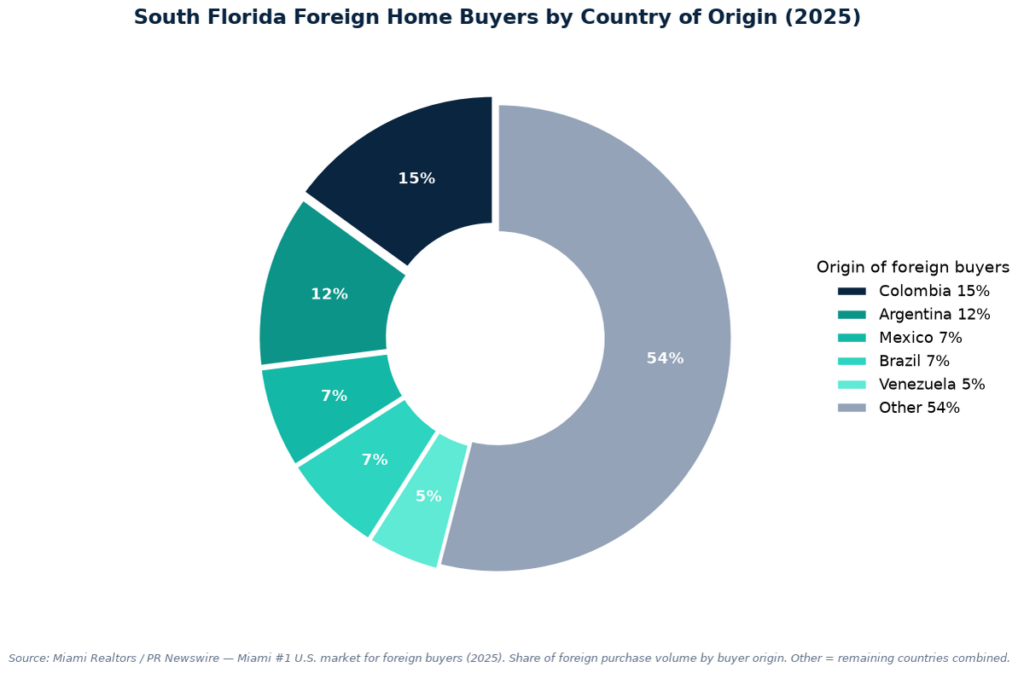
South Florida remains the top U.S. market for foreign home buyers. According to the Miami Realtors report carried by PR Newswire (2025):
- Foreign buyers accounted for about 15% of South Florida transaction volume in 2025, versus roughly 2% nationwide in the U.S.
- Foreign volume was about USD $4.4 billion, across roughly 5,300 purchases.
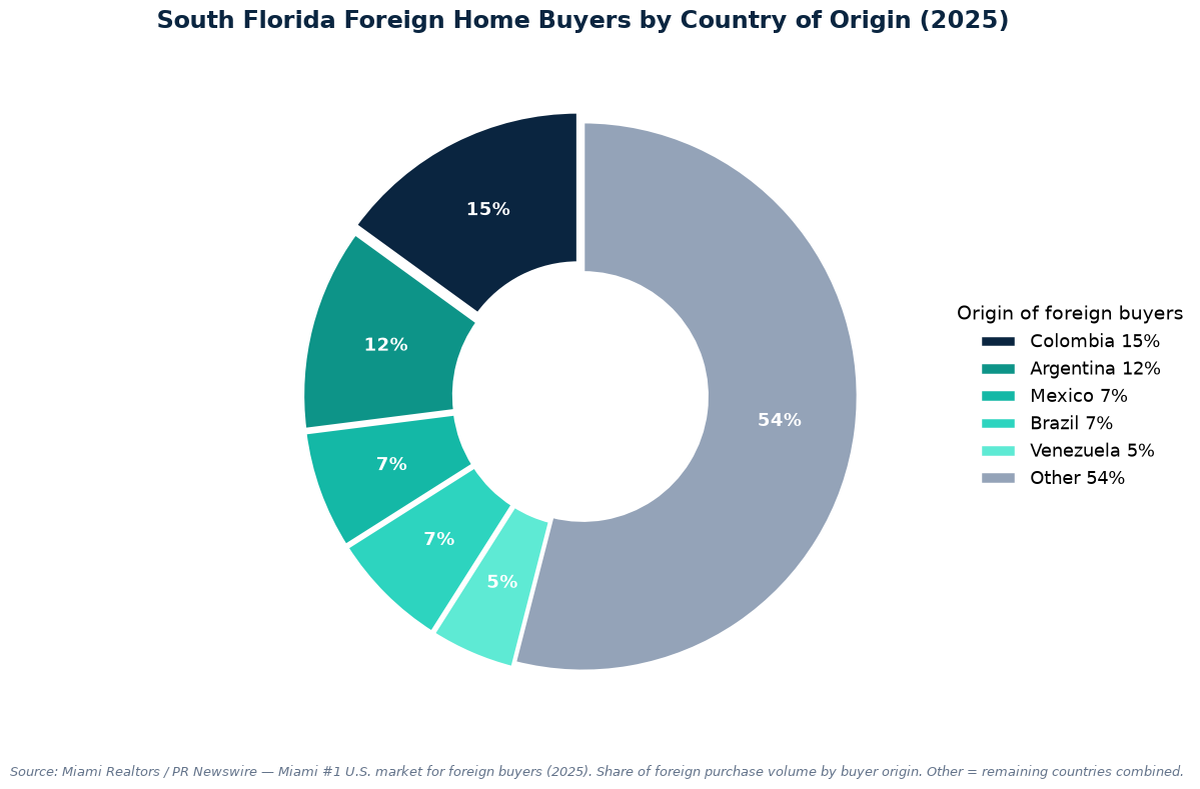
- Top origins by foreign volume share: Colombia 15%, Argentina 12%, Mexico 7%, Brazil 7%, Venezuela 5% (remainder: other countries).
- Median foreign purchase price: USD $558,700; the median for Mexico-origin buyers was higher, about USD $934,000.
- 51% paid cash; 51% bought condos; 71% used the property for vacation or rental; 65% had visited Florida two times or fewer; 11% had never visited.
Source: Miami is #1 U.S. market for foreign home buyers (PR Newswire).
On new construction, a Miami Realtors report (July 2025) found that global buyers purchased about 49% of new construction / pre-construction / conversion units over an 18-month period through July 2025, with Latin Americans in the majority. Source: New International Report — Miami Realtors.
For country-specific angles, Lata Miami publishes guides such as investing from Mexico, international investing, and the Argentina how-to: buy an apartment in Miami from Argentina (Spanish twin: cómo comprar apartamento en Miami desde Argentina).
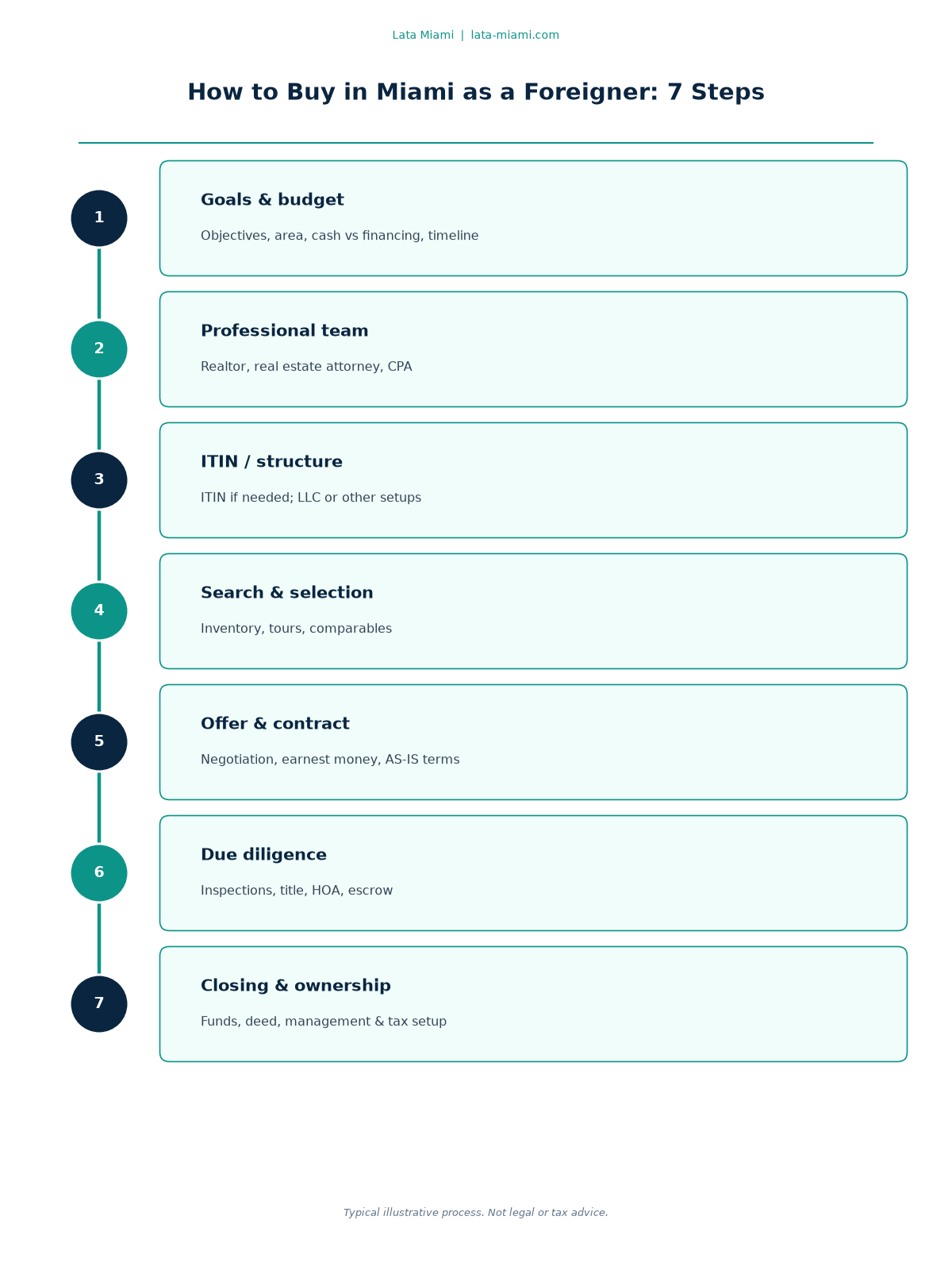
How to buy property in Miami as a foreigner: 7-step process
The typical (illustrative) flow for a Latin American buyer without a visa looks like this. Timelines vary with financing, property type (resale vs. pre-construction), and due-diligence complexity.
1. Define goals and budget
Clarify whether you want a vacation home, short- or long-term rental, eventual housing for family, or a mix. Set a price range, preferred areas (Brickell, Downtown, Edgewater, Miami Beach, Coral Gables, Doral, Sunny Isles, and others), and whether you will pay cash or seek financing. A realistic budget includes purchase price plus closing costs, insurance, HOA/condo fees, maintenance, and annual taxes.
2. Assemble the professional team
For a foreign buyer, the recommended minimum team is:
- A realtor experienced with international clients.
- A Florida real estate attorney (contract, title, HOA review).
- A CPA or tax advisor experienced with FIRPTA / foreign persons.
- As needed: a property manager and a mortgage broker familiar with foreign nationals.
Lata Miami (Cosmore Florida Corp.) coordinates integrated advisory—real estate, tax, and immigration when relevant. Contact: info@lata-miami.com | +1 786-536-2344 | 1200 Brickell Ave, Ste 250, Miami.
3. ITIN, ownership structure, and funding prep
Many buyers obtain an ITIN for filings or reporting. Some purchase in their personal name; others evaluate an LLC or another structure (each with its own costs and obligations). The right choice depends on liability, estate planning, taxes, and rental plans—there is no one-size-fits-all answer. Plan international wires with banks that handle cross-border transfers and document the source of capital.
4. Search and selection
Review resale inventory and, if interested, pre-construction. Compare HOA fees, building reserves, rental rules, estimated taxes, and neighborhood liquidity. If you cannot travel, virtual tours are common—the finding that 11% of foreign buyers had never visited Florida shows the market already works this way—but a professional inspection remains critical.
Start with the properties for purchase hub.
5. Offer, negotiation, and contract
Florida commonly uses a standard residential contract (plus addenda). Earnest money goes into escrow. Many sales are AS-IS: the buyer inspects and decides whether to proceed, within contract cancellation windows. Your attorney should review condo/HOA restrictions, special assessments, and financing clauses.
6. Due diligence: inspections, title, and HOA
During the inspection period: licensed inspector, title commitment review, condo/HOA estoppel, insurance, and—if renting—permit status. The title company or attorney runs escrow and issues title insurance. Clear title objections before closing.
7. Closing, possession, and operations
At closing you sign documents, wire funds, and record the deed. Afterward: keys, utilities, insurance, property management if needed, and a tax calendar (federal/state filings as applicable). If you later sell as a foreign person, FIRPTA may apply (see below).
Cash vs. financing as a foreign buyer
Per the 2025 report cited above, about 51% of foreign purchases in South Florida were all-cash. Cash often strengthens an offer and reduces loan contingencies, but it does not replace due diligence.
Financing for foreign nationals is available through some banks and specialty lenders, usually with stricter requirements (larger down payments, foreign income documentation, reserves). Terms change; we do not invent down-payment percentages here. Talk to a mortgage broker and your CPA before signing a contract with a financing contingency.
Condo vs. single-family: what foreign buyers choose
The same report notes that about 51% of foreign purchases were condominiums, and 71% were for vacation or rental use. Condos often offer amenities and simpler remote management, in exchange for HOA fees and rental rules. Single-family homes can suit families or buyers seeking fewer association restrictions, with more maintenance responsibility.
In new construction / pre-construction, the ~49% global-buyer share in the reported period underscores the need to review developer contracts, deposit schedules, delivery dates, and delay risk—always with an attorney.
Taxes, FIRPTA, and ongoing costs (high-level)
At purchase
Florida closing costs typically include title insurance, closing fees, documentary stamp taxes (depending on the instrument), and prorations. Exact amounts depend on price and structure; ask your title company or attorney for an estimated closing statement.
While you own
Typical annual budget items (concepts only—not invented official rates):
- County property tax.
- Insurance (hazard / wind / flood as required by location, lender, or prudence).
- HOA or condo association fees.
- Maintenance, utilities, and—if renting—management fees plus local short-term rental compliance.
On sale: FIRPTA
When a foreign person disposes of a U.S. real property interest, FIRPTA withholding often applies. In the typical case, withholding is 15% of the amount realized (generally the sales price), not of the gain—subject to exceptions or reduced rates under the rules. The buyer (or withholding agent) is usually responsible for remitting the tax to the IRS; the foreign seller then files a return to compute actual tax and claim a credit or refund if applicable.
Official source: IRS — FIRPTA Withholding.
Plan your exit with your CPA before listing. More context: Lata Miami tax services.
Common mistakes Latin American buyers make
- Assuming a purchase equals the right to live or work in the U.S. It does not; immigration is separate (visas).
- Signing without a Florida attorney—especially on pre-construction or complex condo docs.
- Underestimating HOA, insurance, and assessments when calculating true monthly cost.
- Ignoring FIRPTA until resale day.
- Choosing a building without checking rental policies if the plan is Airbnb or short-term stays.
- Last-minute wires without bank compliance ready (delays and missed closing dates).
- Comparing only price per square foot without liquidity, competing inventory, and condo management quality.
Country angles: Mexico, Argentina, and international buyers
Each origin country has nuances around FX, banking paperwork, and investment culture:
- Buyers from Mexico: investment guide.
- Buyers from Argentina: EN — Buy apartment in Miami from Argentina and ES twin.
- Regional overview: international investing.
This pillar complements those articles: the focus here is the general no visa / no residency framework for Latin America as a whole.
How Lata Miami supports foreign buyers
Lata Miami (operated by Cosmore Florida Corp.) connects Latin American buyers and investors with Miami opportunities: property search, coordination with attorneys and CPAs, and tax/immigration guidance when requested.
- Email: info@lata-miami.com
- Phone / WhatsApp: +1 786-536-2344
- Office: 1200 Brickell Ave, Suite 250, Miami, FL
CTA: request an advisory consultation (no purchase obligation) to review your profile, budget, and next steps. Start at Buy or email info@lata-miami.com.
Frequently asked questions (FAQ)
Do I need a visa to buy a house or apartment in Miami?
No. Purchasing real estate does not require a visa or residency. You will need identification, the ability to fund the deal, and compliance with Florida’s legal/commercial process.
Does buying property give me a green card?
No. Acquiring real estate does not confer immigration status. Visa programs (including investor options) are independent; see visa services.
Can I buy entirely remotely?
Many buyers use a power of attorney, virtual tours, and remote closing when the title company and attorney allow it. A professional on-site inspection is still strongly recommended.
What is FIRPTA in plain language?
It is an IRS regime that, in the typical case, withholds 15% of the sales amount when the seller is a foreign person, to support federal tax compliance. Official detail: IRS FIRPTA page.
Condo or single-family for a non-resident?
It depends on use. 2025 data show strong condo and vacation/rental share among foreign buyers, but the right choice is personal: HOA, rental rules, maintenance, and location drive the decision.
How long does the process take?
An all-cash resale can close in a few weeks if nothing goes wrong; financing or pre-construction stretches the timeline. Your team will set a realistic calendar.
Conclusion
Buying property in Miami as a foreigner—with no visa and no residency—is legally viable and well established among buyers from Colombia, Argentina, Mexico, Brazil, Venezuela, and the rest of Latin America. Success depends less on an immigration “shortcut” (there is none through purchase alone) and more on: a local team, due diligence, tax structure that anticipates FIRPTA, and a budget that includes holding costs.
Use this guide as a map, verify figures in the cited sources, and speak with licensed professionals before offering. When you are ready, Lata Miami can help organize the next step: info@lata-miami.com | +1 786-536-2344.
Editorial update: 2026. Market statistics cited from 2025 Miami Realtors / PR Newswire reports and the IRS (FIRPTA). Lata Miami / Cosmore Florida Corp.